What size camper do you need? For us, the question was “what size camper can you afford?” The answer was the petite, 22’ Forest River Wildwood FSX pictured above. It’s called a Tow-Trailer because one needs a truck to pull it. We paid $17K for our gently-used camper and added another $1500 for parts and labor (generator, new propane/generator holder and a more stable connector with the truck).
Our truck took a long time to find. Eventually, we purchased a 2015 Ford F150 Lariat that was on the lot of our daughter’s Nissan dealership in Yorktown Heights, New York. This set us back (gulp) $37K.
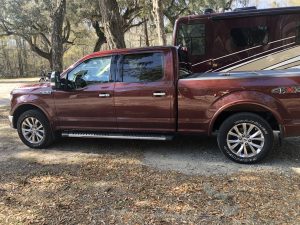
The only way to go cheaper is to buy an older or smaller camper, but we wanted something safe and well-preserved because we planned to live and work in it for a while. As to a vehicle, our research indicated that one needs a serious truck, especially if you’re going over any mountains. A Ford F150 is plenty of truck for this camper, but for the 35′ campers (or bigger) you’re going to need a diesel engine, so that puts you into the category of an F250 or F350. These trucks are massive and will set you back more – $50-80K.
You can avoid the truck purchase. As you can see in the background, our new neighbor has a different type of home. His is called a Class A Motorhome. These are really buses turned into an RV. A motorhome like this will cost you between $100-450K. Yup. It’s like buying a house!
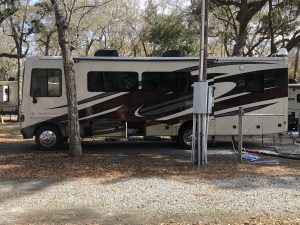
Class A or Class C campers are RVs that have motors, so you don’t need a truck to pull them. However, most folks who purchase them tow a small vehicle behind them. The reason is that once you pull into a site and setup a camp – you’re going to want to take day trips. In that case, packing up your camper (whatever size it is) is a pain in the butt. Here’s a few options (and there are more)…
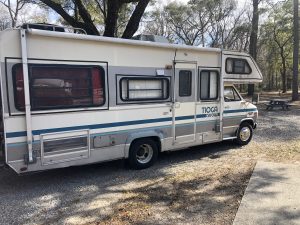
Class C Motorhome
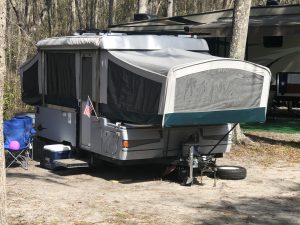
Pop-Up
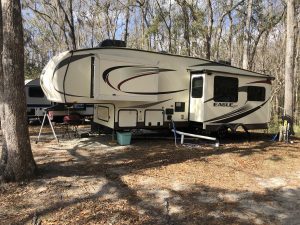
Fifth Wheel
I like our 22′ camper. It’s a breeze to tow and it’s simple to clean up because there’s not enough room inside to make much of a mess! It takes some getting used to because the environment is tiny – even compared to a studio apartment – but it suits Beth, me, and Bradley just fine. Sure, we have to ask Bradley to move so that we can open a cabinet or the fridge, but that’s just the way it is.
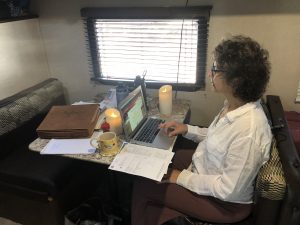
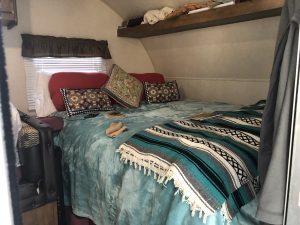
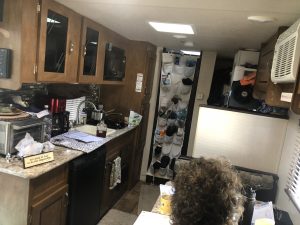
No matter what camper you choose, you have to learn how to use it. At first, it seemed like a steep learning curve to master the septic, propane, and electric systems in addition to the driving and the setup. But we got it under control after a few days. If it were rocket science, a lot of RVers wouldn’t be doing it. I’ve met single women who do it all themselves and older, retired people, too. There’s a bunch to learn, but the technology is pretty user-friendly and there’s loads of videos online to answer your questions.
If you’re interested in talking about RVs, I’m open to talking with you!